
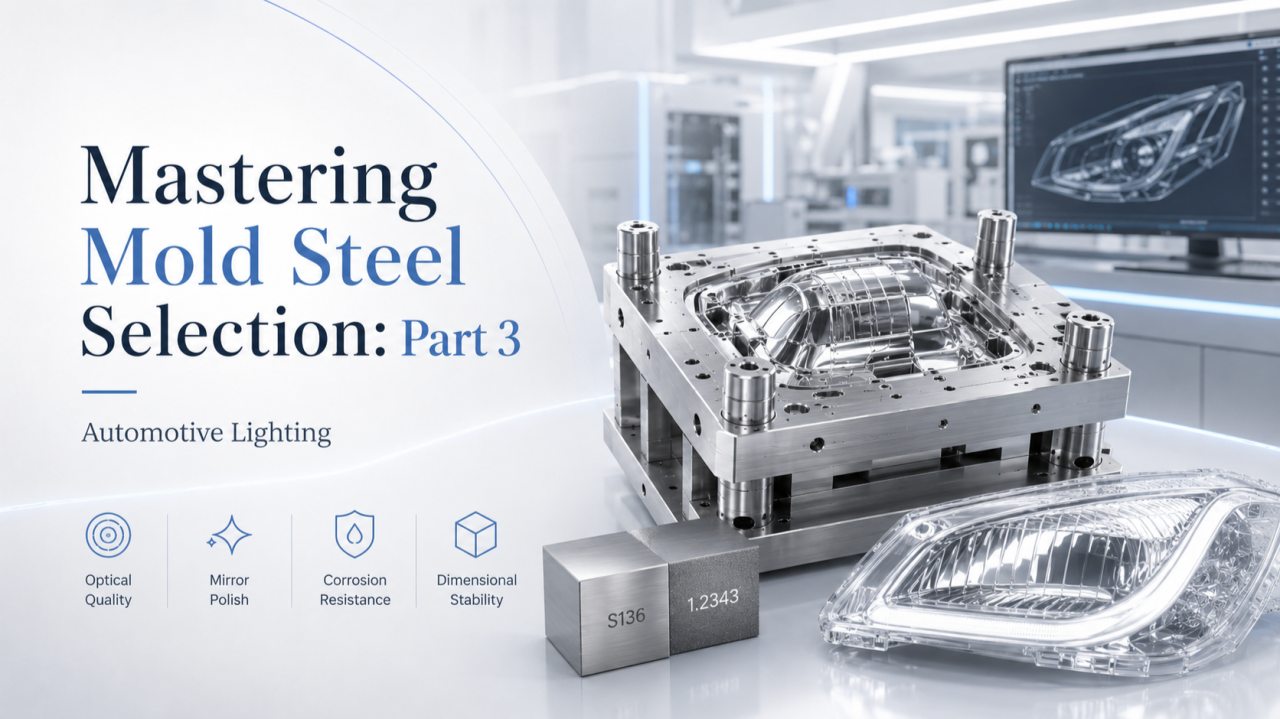
In the automotive sector, headlamps and tail lamps are far more than simple illumination components. They are complex optical systems that influence vehicle identity, safety performance, visual quality, and long-term reliability.
Compared with standard lighting products, automotive lighting components often involve complex geometries, deep cavities, large height variations, thin-wall sections, high-gloss surfaces, and specialized optical features. These molds must also perform consistently through high-volume production cycles.
Steel selection for automotive lighting molds therefore requires a partitioned strategy based on the specific function of each key component: housing, bezel, reflector, and lens.
1. Core Selection Logic: Beyond Surface Polish
Automotive lighting molds demand more than a high surface finish. Engineers must consider several critical factors:
High dimensional stability Essential for complex assembly tolerances and long-term part consistency.
Thermal fatigue resistance Important for repeated molding cycles and long-term mold reliability.
Low notch sensitivity Critical for deep cavities, sharp transitions, thin inserts, and high-stress areas.
Metallurgical purity Especially important in optical and high-gloss zones, where microscopic defects can be visually magnified.
Stable polishability Required for lenses, reflectors, bezels, and other visible or optical surfaces.
In many automotive lighting and automotive mold applications, 1.2343 and 1.2344 are commonly evaluated steel systems. For high-polish and optical requirements, 1.2343 ESR is often preferred because of its higher cleanliness, better microstructural uniformity, and more stable polishing behavior.
2. Component-Specific Material Strategies
ComponentFunction & ResinRecommended SteelTechnical LogicHousingStructural support, sealing, and assembly. Often uses PP, ABS, PC/ABS, PBT, PA, or glass-fiber-reinforced materials.1.2344 / 1.2343Focus on toughness, dimensional stability, and wear resistance, especially for ribs, bosses, clips, and glass-fiber flow areas.BezelDecorative transition part. May require plating, spraying, vacuum metallization, or high-gloss finish.1.2343 / 1.2344 / 1.2343 ESRFor high-gloss or surface-treatment areas, ESR-grade steel helps reduce polishing defects, pitting, orange peel, and surface inconsistency.ReflectorCritical optical reflection and light distribution surface.1.2343 ESRProvides high cleanliness and homogeneous structure for optical surfaces, reflective stability, and reliable integration with precision electroformed components.LensTransparent part, often made from PC or PMMA. Highly sensitive to visual and optical defects.1.2343 ESROffers a strong balance of polishability, toughness, dimensional stability, and thermal fatigue resistance for demanding automotive lighting molds.
3. Reflector Molds and Electroformed Optical Components
For reflectors, reflector bowls, and light distribution surfaces, the mold surface is not merely cosmetic. It directly affects reflection behavior, beam distribution, optical efficiency, and final lighting performance.
In some high-end automotive lighting molds, the most demanding optical reflection features may not be produced directly on the main steel cavity block. Instead, mold makers may use precision electroformed optical mold components supplied by specialized companies. DBM is one of the well-known companies in this field, and its electroformed mold components are widely recognized for high-precision reflective features and complex optical surfaces.
However, using precision electroformed optical components does not reduce the importance of the base mold steel. The supporting steel structure must still provide sufficient rigidity, dimensional stability, heat treatment stability, insert-fitting accuracy, and long-term assembly reliability.
If the base steel suffers from deformation, stress release, local cracking, poor insert support, or unstable fitting accuracy, even a high-precision electroformed component may not deliver stable optical performance during long-term production.
4. The Technical Advantage of ESR Refining
For complex automotive lighting molds, notch sensitivity is one of the key risks behind cracking, chipping, or early fatigue failure. Deep cavities, sharp corners, thin inserts, ribs, shut-off areas, and large height differences can all create local stress concentration.
The ESR process helps improve steel cleanliness and microstructural uniformity. By reducing non-metallic inclusions, segregation, and internal porosity, ESR steel provides more stable polishing performance and better reliability in high-demand mold areas.
For optical zones, this is especially valuable. Small defects in the steel may become polishing pits, clouding, uneven reflection, or visual defects on the final part. In these areas, steel purity is not only a material property; it becomes part of optical quality control.
5. Large-Scale Mold Risks
As the physical size of the mold block increases, the risk of internal defects such as segregation, porosity, looseness, or inclusion concentration also increases.
In optical or high-gloss areas, these defects may not appear during rough machining. They often become visible only during final machining, polishing, mold trial, or mass production. Once porosity clusters, exposed inclusions, or local structural abnormalities appear in a critical optical zone, repair is often extremely difficult and costly.
Therefore, evaluating a steel mill’s melting capability, ESR process control, ultrasonic testing standards, batch consistency, and experience with large-size mold steel is as important as choosing the grade itself.
Technical Summary
A mature steel selection strategy for automotive lighting molds should avoid a one-size-fits-all approach.
Housing areas may prioritize toughness, wear resistance, and dimensional stability. Bezel areas may require surface quality, polishing response, and compatibility with secondary finishing. Reflector areas must focus on optical stability, steel cleanliness, and integration with precision electroformed components. Lens areas require high polishability, defect control, and long-term surface stability.
By using 1.2343 ESR for critical optical and high-polish zones, while applying high-quality 1.2343 or 1.2344 in structural and functional areas, engineers can balance optical performance, mold reliability, and overall project cost.
Automotive lighting technology continues to evolve, and mold steel selection must evolve with it.
In your experience, how do you balance steel purity, mold life, maintenance intervals, and cost control in high-cycle automotive lighting production?
We welcome your experience, perspectives, and technical discussions.
Written by Billy Peng GM of CF-STiEHL USA
#MoldMaking #InjectionMolding #MoldSteel #AutomotiveLighting #AutomotiveTooling #OpticalMolding #HotWorkSteel #ESRSteel #PrecisionManufacturing #SteelSelection #Tooling