
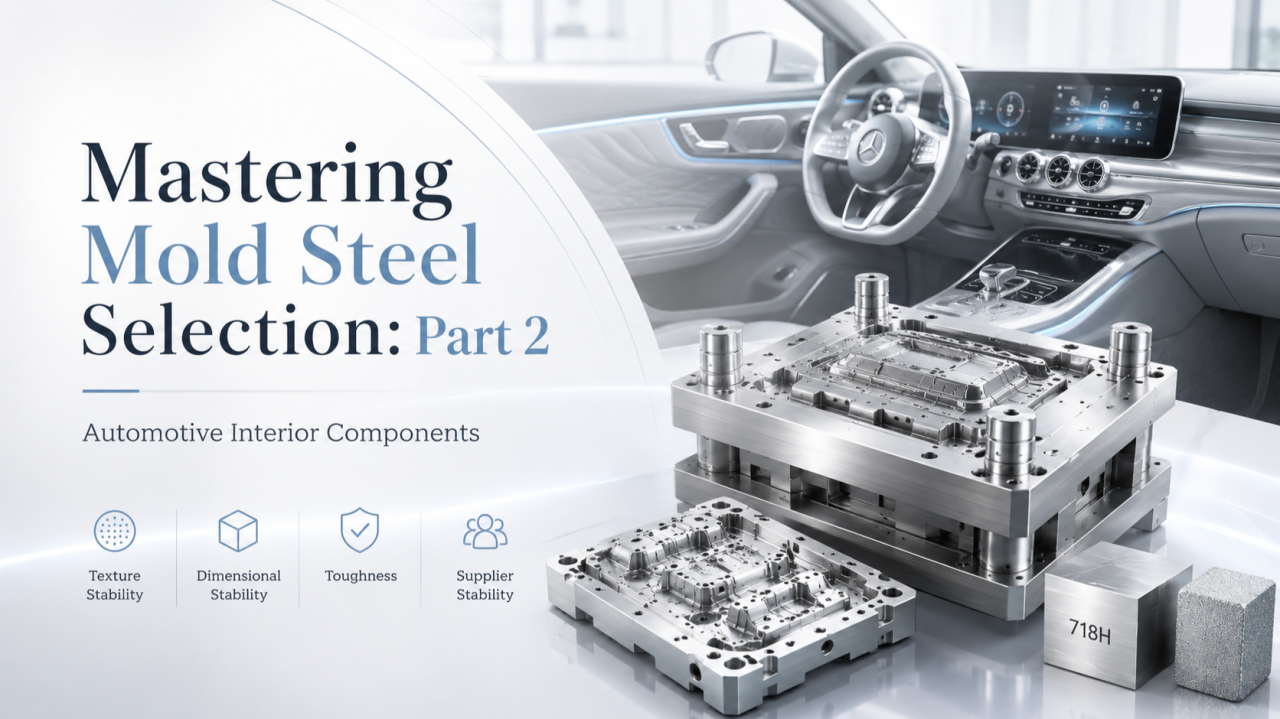
In automotive interior molding, steel selection is not only about mold life. It directly affects surface texture quality, dimensional stability, assembly accuracy, production efficiency, and long-term consistency across high-volume programs.
Unlike many general plastic components, automotive interior parts often combine large surface areas, strict appearance requirements, complex geometry, multiple assembly features, and demanding customer validation standards. Door panels, instrument panel components, center consoles, pillar trims, glove boxes, air outlet housings, decorative trims, and functional brackets may all require different steel selection strategies within the same interior system.
For molds expected to support long-term production, stable steel performance becomes the foundation for repeatable part quality.
1. Key Requirements of Automotive Interior Parts
Automotive interior components usually face several combined requirements:
Large mold size and long flow length
High surface texture consistency
Low deformation risk after machining
Stable dimensional accuracy
Good toughness for complex mold actions
Reliable performance under repeated production cycles
Good weld repair and maintenance behavior
Compatibility with graining, polishing, or surface treatment
In many projects, the real challenge is not simply achieving higher hardness. The more important challenge is maintaining stable surface quality and dimensional consistency throughout machining, mold trials, adjustment, and long-term mass production.
2. Appearance Interior Parts: Texture Stability Comes First
Typical applications include:
Door panels
Instrument panel upper and lower components
Center console covers
A/B/C pillar trims
Seat back panels
Interior decorative covers
Recommended Steel Family: 718H / P20+Ni Type Pre-Hardened Steel
For large automotive interior appearance parts, 718H-type pre-hardened steel is commonly used because it provides a practical balance among machinability, toughness, polishability, and dimensional stability.
The addition of nickel helps improve cross-sectional hardness uniformity, which is especially important for large mold plates and deep cavity structures. When the mold surface requires chemical graining, leather texture, matte texture, or fine surface patterns, steel homogeneity becomes critical.
If the steel structure is not homogeneous enough, the final texture may show uneven gloss, inconsistent texture depth, or visible surface differences across the molded part.
For large interior appearance molds, the key value of 718H-type steel is not only its hardness, but also its ability to support stable machining and consistent surface finishing.
3. Structural and Functional Interior Parts: Toughness and Machinability Matter
Typical applications include:
Air outlet housings
Glove box structures
Clip areas
Mounting brackets
Hidden support structures
Seat-related plastic structures
Internal reinforcement parts
Recommended Steel Family: 738 / 1.2738 Type Pre-Hardened Steel
For core-side structures, slides, lifters, deep ribs, undercuts, and areas exposed to repeated mechanical stress, toughness and machining stability are often more important than mirror surface quality.
738 / 1.2738-type steels are widely used for mold components that require stable machining performance, good toughness, and structural reliability. These steels are suitable for medium to large molds with complex movement mechanisms, especially where repeated ejection, side action, sliding, and clamping loads are involved.
Automotive interior parts often contain many clips, ribs, screw bosses, and snap-fit structures. These areas can create high local stress on mold inserts. If the steel lacks toughness or the local structure is not properly designed, cracking, chipping, or premature wear may occur.
For these applications, steel selection should be evaluated together with insert design, cooling layout, machining method, and expected maintenance cycle.
4. High-Texture and Low-Gloss Interior Surfaces
Automotive interiors increasingly emphasize tactile quality and visual consistency. Low-gloss textures, leather-like grains, fine matte surfaces, and decorative patterns are widely used to improve perceived quality.
For these surfaces, the mold steel must support:
Uniform chemical graining
Consistent texture depth
Stable gloss level
Low risk of surface clouding
Good repairability
Minimal polishing or graining defects
Steel cleanliness and microstructural homogeneity are important because any local inconsistency in the steel may appear as texture variation on the molded part.
For premium interior parts, especially visible panels with large surface areas, higher-quality pre-hardened steel or ESR-refined steel may be considered when the project requires very stable texture quality over long production cycles.
5. Transparent or High-Gloss Interior Components
Typical applications include:
Display windows
Light guide components
Transparent buttons
Decorative clear covers
High-gloss interior trims
Recommended Steel Family: S136 / 420 Stainless Mold Steel
For transparent, high-gloss, or high-polish automotive interior parts, stainless mold steel such as S136 is often a more suitable choice.
After proper heat treatment, S136 can provide higher hardness, better corrosion resistance, and improved mirror-polishing performance. Its high chromium content also helps protect the mold surface from corrosion caused by moisture, resin additives, or gases generated during processing.
For optical-grade or demanding high-gloss applications, ESR-grade S136 is usually preferred. ESR processing improves steel cleanliness and reduces the risk of polishing pits, orange peel, haze, clouding, or inconsistent reflection.
This is especially important for parts located near displays, control panels, ambient lighting areas, or premium decorative surfaces where small defects are visually noticeable.
6. Resin Type and Steel Selection
Automotive interior parts commonly use materials such as PP, ABS, PC/ABS, ASA, TPO, PA, and reinforced engineering plastics.
Different resins create different demands on mold steel:
PP and TPO usually require good texture stability and dimensional control.
ABS and PC/ABS often require better surface quality and polishability.
ASA may require improved corrosion resistance depending on additives.
Glass-fiber-reinforced materials require stronger wear resistance in high-flow or high-friction areas.
Flame-retardant materials may release corrosive gases and therefore require better corrosion protection.
Steel selection should never be separated from resin type. A mold using unfilled PP and a mold using glass-filled PA may look similar in structure, but the steel wear requirements can be very different.
7. Why Steel Uniformity Is Critical for Large Automotive Interior Molds
Automotive interior molds are often large and complex. Large mold plates require stable hardness distribution from surface to core. If the steel has poor cross-sectional uniformity, several issues may appear:
Machining stress release
Uneven deformation
Inconsistent polishing behavior
Texture variation
Unstable part dimensions
Difficulty during mold adjustment
For large molds, steel uniformity can sometimes be more important than simply choosing a higher nominal hardness. Stable internal quality helps reduce unexpected problems during machining, assembly, trial molding, and mass production.
At the same time, because automotive molds are usually large in size, especially fixed-side cavity plates, steel selection must also consider the quality stability and batch consistency of the steel supplier in addition to hardness, toughness, polishability, texture stability, and machinability.
Large-section steel requires stronger control over internal density and cleanliness during melting, forging, rolling, and heat treatment. As the material section size increases, the risk of internal porosity, looseness, segregation, inclusion concentration, and other defects also increases. For automotive interior appearance molds, these risks must be controlled before machining begins.
Many internal defects are not easy to identify during rough machining or semi-finishing. They may only become visible during final machining, polishing, graining, or even mold trials. If porosity clusters, exposed inclusions, or local structural abnormalities are discovered during polishing on a large fixed-side cavity area, the problem is often very difficult to fully repair through later processing. In severe cases, the entire cavity plate may need to be reworked or replaced.
Therefore, for large automotive interior molds, steel selection should not be based only on grade and price. It should also include a practical evaluation of the steel mill’s melting capability, quality stability, inspection standards, ultrasonic testing requirements, batch records, and proven experience with large-size mold steels.
For critical appearance surfaces and high-value molds, choosing a stable and dependable steel supplier is itself an important step in reducing project risk.
8. Technical Understanding: Cost Optimization Must Be Based on Function
A practical steel selection strategy for automotive interior molds should not apply the same steel everywhere.
A more mature approach is to classify mold areas by function:
Appearance cavity surfaces require polishability, texture consistency, and dimensional stability.
Core-side structures require toughness, machinability, and fatigue resistance.
Sliding and moving components require wear resistance and stable mechanical strength.
Transparent or high-gloss areas require high purity and mirror-polishing capability.
Corrosion-sensitive areas may require stainless steel or surface protection solutions.
This function-based strategy helps control cost while still maintaining mold reliability.
The goal is not to use the most expensive steel throughout the mold. The goal is to use the right steel in the right location.
Conclusion
Steel selection for automotive interior molds is a system decision. It must consider part function, resin type, appearance requirements, texture quality, mold size, expected production volume, machining process, surface treatment, steel supplier stability, and maintenance strategy.
For large appearance parts, 718H / P20+Ni type pre-hardened steel can provide a strong balance of surface quality, machinability, and dimensional stability.
For structural and core-side components, 738 / 1.2738-type steel can offer reliable toughness and machining performance.
For transparent, high-gloss, or premium decorative parts, S136 or ESR-grade stainless mold steel may provide better polishing and corrosion resistance.
For large fixed-side cavity plates, the steel supplier’s quality stability, internal defect control, inspection capability, and large-section steel experience should also be treated as key selection factors.
In automotive interior tooling, the best steel choice is not always the highest-grade option. It is the material solution that provides the most stable performance at the most reasonable total cost for the specific application.
As a mold base manufacturing team serving automotive, home appliance, medical, and high-precision injection molding industries, we hope this discussion can bring more practical insights from professionals in mold making, injection molding, material engineering, and precision manufacturing.
In your experience, what is the most important factor when selecting steel for automotive interior molds: texture consistency, mold life, cost control, supplier stability, or long-term dimensional stability?
We welcome your experience, perspectives, and technical discussions.
Written by Billy Peng,GM of CF-STiEHL
#MoldMaking #InjectionMolding #MoldSteel #AutomotiveInterior #AutomotiveTooling #MaterialsScience #PrecisionManufacturing #SteelSelection #Tooling #EngineeringExcellence