
A Practical View on Mold Base Process Division, Total Cost, and Process Control
By Billy Peng
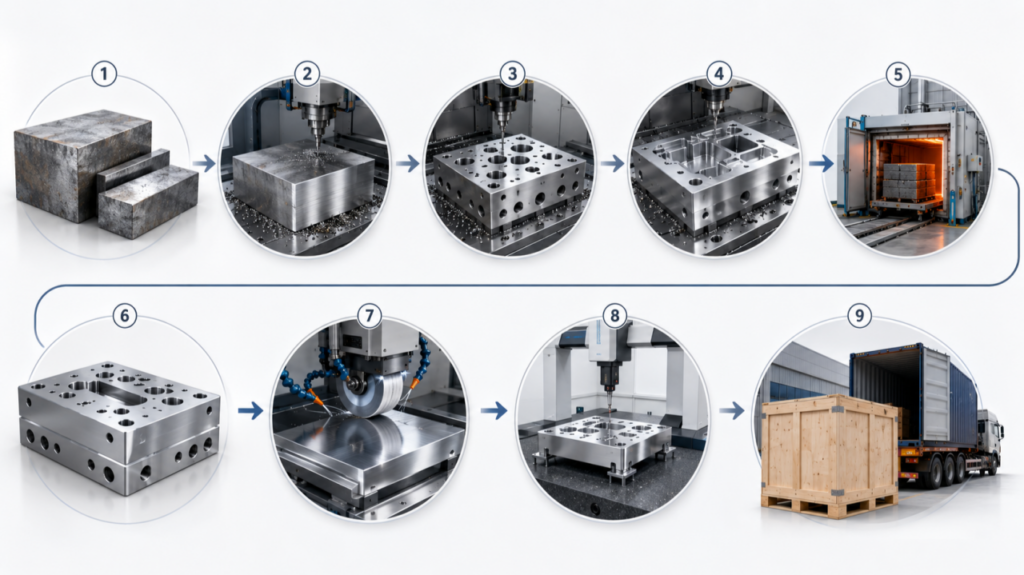
In mold manufacturing, buying machined plates is a very common and straightforward approach. A mold shop purchases prepared steel plates, then completes drilling, tapping, deep-hole drilling, guide pin and bushing work, lifting holes, hot runner plate machining, rough cavity pocketing, and final finishing in its own facility.
I fully understand why many North American mold builders prefer this approach. Keeping more work in-house gives a shop better control over engineering changes, critical dimensions, confidentiality, customer communication, and final tool quality.
At the same time, from what I have seen in different mold manufacturing environments, buying only plain machined plates is not always the lowest-cost or most efficient option when we look at the full process.
In my view, the more useful question is not simply:
“What is the price of the plate?”
A better question may be:
“Which operations are better handled by a qualified supplier before the plates arrive, and which operations should remain under the mold builder’s direct control?”
This article is not meant to give one universal answer. It is simply a practical perspective based on my own experience in mold base machining, mold manufacturing, and supply chain coordination. I would also be very interested to hear how North American mold builders think about this topic.
1. A machined plate is not just a flat piece of steel
A machined mold plate may look simple. In basic terms, it is a piece of tool steel that has been cut, milled, ground, or otherwise prepared for further machining.
But in real mold manufacturing, the plate is the foundation of the entire tool.
If material condition, internal stress, flatness, parallelism, squareness, datum control, or machining allowance are not handled well, later mold manufacturing operations can become more difficult.
This is especially true for large A plates, B plates, support plates, hot runner plates, and clamping plates. In my experience, several factors deserve attention:
- material grade and hardness condition;
- internal stress after steel cutting;
- roughing and finishing sequence;
- datum surface and datum edge definition;
- flatness, parallelism, and squareness;
- machining allowance for later operations;
- clamping and support method during machining.
A good machined plate is not only about meeting dimensions. It should provide a stable and reliable foundation for the next steps of mold manufacturing.
2. A few key points in machined plate preparation
2.1 Material condition comes first
Different steel grades, hardness conditions, and heat treatment states behave differently during machining.
For example, P20, 1.2311, 1.2738, 420, 2083, 4140, H13, and other mold steels may all have different machining characteristics. For thick and large plates, internal stress can become a real issue. After heavy material removal, deep-hole drilling, or two-side machining, deformation may occur if the material condition is not stable.
So, in my opinion, the first step in machined plate preparation is not just cutting and milling. It is also understanding whether the material condition is suitable for the downstream machining plan.
2.2 Rough machining should consider stress release
For large plates, I generally prefer not to remove all stock from one side in a single operation. A more stable method is to machine both sides in steps, remove stock more symmetrically, and perform intermediate inspection when needed.
If too much material is removed from one side, the plate may bend or warp after machining. This issue is especially common on large mold base plates, hot runner plates, and cavity/core plates.
2.3 Datum strategy needs to be planned early
Even though a machined plate is still a semi-finished component, datum control is very important.
Guide pin and bushing holes, threaded holes, lifting holes, deep holes, hot runner reliefs, and rough cavity pockets should all be built from a clear datum system. If the datum strategy is not clear, individual dimensions may look acceptable, but accumulated error may still appear after the mold base is assembled.
At the plate machining stage, I would usually want to clarify:
- which surface is the primary datum;
- which edge is the main datum edge;
- how hole patterns and pocket locations are built from the datum;
- whether the inspection report follows the same datum system as the drawing.
2.4 Large plate machining must consider clamping distortion
The larger the plate, the more important the clamping method becomes.
If clamping positions, support points, or clamping force are not properly controlled, the plate may be forced flat during machining and then spring back after being released. In that case, the part may look acceptable on the machine, but problems may appear during assembly or secondary machining.
For large plates, I believe uniform support, stable clamping, and avoiding over-clamping are just as important as the machining program itself.
3. Why buying only plain plates may not result in the lowest total cost
Many mold shops prefer to buy plain machined plates and complete all subsequent operations internally. I understand the reason. It gives the shop direct control, especially over critical cavity work and final precision.
However, not every operation has the same level of technical sensitivity.
Many basic operations are relatively standardized and repetitive, such as:
- threaded holes;
- standard drilled holes;
- counterbores;
- lifting holes;
- deep-hole drilling;
- guide pin and bushing holes;
- guide pin and bushing installation;
- basic hole patterns for ejector plates, support plates, and clamping plates;
- rough pocketing on A and B plates;
- basic hot runner plate relief machining;
- preliminary mold base assembly and checking.
These operations may not directly define the final molded part surface, but they still consume machine time, programming time, setup time, inspection time, and internal scheduling capacity.
When all of this work is performed inside a North American mold shop, the real cost is not only cutting time. It also includes machine availability, labor cost, scheduling pressure, subcontractor coordination, handling, logistics, and possible rework.
That is why I believe the lowest purchase price for a plain plate does not always mean the lowest total mold manufacturing cost.
4. Which operations may be suitable for pre-machining?
From a practical project standpoint, some basic operations can be considered for pre-machining by a specialized mold base or plate machining supplier, while the mold builder keeps critical semi-finishing and final finishing under its own control.
To me, this is not about outsourcing core know-how. It is about matching the right process with the right capability.
4.1 Threaded holes and basic hole patterns
Threaded holes, mounting holes, clearance holes, and lifting holes are often repetitive. If the drawing is clear and the datum system is well defined, these operations can often be completed efficiently by a qualified supplier.
For large molds, lifting holes are not just a machining feature. They also affect handling, assembly, and safety.
4.2 Deep-hole drilling
Deep-hole drilling may look simple, but in practice it requires suitable equipment, tooling, coolant control, chip evacuation, straightness control, and operator experience.
If a mold shop does not have dedicated deep-hole drilling capability, or if the work needs to be subcontracted locally, cost and lead time pressure can increase. For basic cooling holes, long through-holes, or holes in non-critical areas, pre-machining may be more efficient.
Of course, if cooling channels are close to final cavity geometry or may still change during design, I would be more cautious. In those cases, some holes can be left for later machining, or additional stock and confirmation areas can be required.
4.3 Guide pin and bushing holes and installation
Guide pin and bushing systems are an important foundation of mold base accuracy. Hole location, bore size, perpendicularity, coaxiality, and fit quality all affect mold opening and closing stability.
If a supplier can machine guide pin and bushing holes, install guide components, and perform preliminary assembly checking, the mold shop receives more than separate plates. It receives a base structure with the main guiding system already established.
This can reduce later fitting work and help identify alignment issues earlier.
4.4 Lifting and handling features
Lifting holes, eye bolt holes, and handling-related features on large plates may look simple, but they are very practical. Completing them in advance can make the plates easier and safer to handle once they arrive at the mold shop.
4.5 Rough pocketing on A and B plates
Large rough pockets on A and B plates often require substantial material removal and occupy CNC capacity for many hours.
If the work is only rough material removal, it does not always have to be completed in the local mold shop. A practical method is to let a qualified supplier complete basic rough pocketing while leaving enough stock for later machining. The mold builder can then complete semi-finishing, finishing, EDM, electrode work, parting line details, and final cavity machining.
For example, depending on the project, the supplier may leave 0.5 mm, 1.0 mm, 2.0 mm, or another specified machining allowance. This can reduce local roughing time without taking final precision control away from the mold builder.
4.6 Basic hot runner plate machining
Hot runner plates often include large relief areas, wire slots, heater clearances, nozzle reliefs, mounting holes, and locating structures.
Many basic relief and non-final precision areas may be suitable for pre-machining. However, nozzle-related locating features, sealing surfaces, and critical hot runner interface areas need to be handled carefully according to the requirements of the mold builder and the hot runner supplier.
A safer approach is to rough machine basic areas first and leave critical fit areas with stock for final machining and confirmation by the local mold shop or hot runner supplier.
5. A balanced approach: pre-machine the foundation, finish the critical areas locally
For many North American mold builders, the real concern is not whether an outside supplier can machine the plates. The more important concerns are:
- whether the drawing is understood correctly;
- whether the dimensions are reliable;
- whether critical areas remain controllable;
- whether problems can be traced;
- whether the mold base will affect final tool quality after arrival;
- whether design changes can still be managed efficiently.
These are all reasonable concerns.
For that reason, I do not think every operation should automatically be pre-machined. A more practical approach is to classify operations into different levels.
Level 1: Basic mold base machining
This includes outside dimensions, plate thickness preparation, standard holes, threaded holes, lifting holes, clearance features, basic reliefs, and non-critical rough machining.
These operations are usually good candidates for pre-machining.
Level 2: Functional mold base accuracy
This includes guide pin and bushing holes, locating holes, plate-to-plate fit, and hole alignment between plates.
These operations can also be completed by a qualified supplier, but only when drawings, datums, inspection requirements, and preliminary assembly checks are clearly defined.
Level 3: Final mold performance features
This includes final cavity and core geometry, parting lines, shut-offs, insert fitting, hot runner sealing areas, final locating surfaces, and any areas that directly affect molded part dimensions.
These operations usually need to remain under the mold builder’s direct control, especially for high-precision, high-risk, or frequently changing projects.
This kind of process division can reduce rough machining and basic machining workload while keeping final mold precision in the hands of the mold builder.
6. Process specialization is a long-term trend
From the perspective of equipment development and manufacturing system evolution, I believe process specialization is a long-term trend.
In the past, many companies wanted one machine, one shop, or one team to solve as many problems as possible. This model can be effective at certain stages, especially when supply chains are unstable, external support is limited, confidentiality requirements are high, or schedules are extremely tight.
For mold builders, having internal capability in design, programming, CNC machining, EDM, grinding, assembly, tryout, and problem solving is still very important. Critical cavity work, parting lines, shut-offs, insert fitting, hot runner critical areas, and final precision control often need to stay inside the mold shop.
At the same time, modern manufacturing equipment has become more specialized. Different machines, processes, and teams are better suited for different types of work.
For example:
- large gantry machining centers are suitable for large plates and basic pocketing;
- deep-hole drilling machines are suitable for long holes, cooling channels, and through-holes;
- high-speed machining centers are suitable for cavities, cores, and precision surfaces;
- horizontal machining centers are suitable for multi-face machining and repeatable structural components;
- grinders are suitable for flatness, parallelism, and thickness control;
- EDM is suitable for details, ribs, deep features, and complex geometry;
- specialized mold base machining systems are suitable for standard hole patterns, guiding systems, lifting systems, plate groups, and preliminary assembly.
So I do not see the future as one machine solving every problem, or one company doing every operation internally. A more mature model may be for a company to maintain its own core capabilities while also developing stable, specialized, long-term supporting suppliers.
These two ideas do not conflict.
A strong mold builder should have internal judgment and key machining capability. At the same time, it should also know which operations are suitable for specialized suppliers and which operations need to stay inside.
Especially in an unstable supply chain environment, internal capability is a form of security. But from the standpoint of long-term efficiency and cost competitiveness, developing the right long-term supplier network is also important.
To me, a competitive manufacturing system is not simply about “doing everything in-house” or “outsourcing everything.” It is about making the right process decisions based on project risk, precision requirements, lead time pressure, equipment suitability, and supplier capability.
7. The more pre-machining is done, the higher the requirement for supplier process control
This type of process division is not simply about giving more work to an outside supplier. It can bring real benefits, such as reducing local rough machining workload, shortening mold build time, reducing basic machining pressure, and improving total cost competitiveness.
But there is also a very practical concern:
The more work is completed outside, the more potential control points are introduced.
If the mold shop only purchases plain plates, the plates can still be adjusted step by step according to the shop’s own design, process habits, and machining strategy. But if the outside supplier has already completed many holes, deep holes, threaded holes, guide pin and bushing work, rough pockets, hot runner reliefs, or even preliminary assembly, any misunderstanding or machining error may become much harder to correct after the plates arrive.
Some problems can be corrected through secondary machining. Others may lead to major rework or even scrapping of the plate. For large plates or complete mold bases, the loss is not only material cost. It also includes schedule delay, remachining, reinspection, logistics, and customer project risk.
7.1 Deep holes, cooling channels, and long holes are not always easy to verify early
Deep-hole drilling is one of the most easily underestimated risk areas.
From the outside, the hole entry location may look correct. However, the hole may drift internally, be too shallow, exit in the wrong location, fail to connect properly with a cross-hole, or contain chips at the bottom. These issues may not be discovered until later machining, assembly, or even tryout.
Common issues include:
- insufficient hole depth;
- excessive hole drift;
- unstable straightness in long holes;
- cross-holes not intersecting correctly;
- blocked cooling channels or remaining chips;
- correct hole entry but internal deviation;
- incorrect plug position, sealing depth, or cooling circuit connection.
Once the plate has already moved into later cavity machining, these problems can be difficult to repair. In serious cases, cooling channel deviation may affect cooling efficiency, mold temperature balance, part deformation, and cycle time.
For deep holes, cooling channels, and long holes, I would not rely only on checking the hole entry location. More detailed inspection and confirmation may be needed, such as hole depth records, hole position checks, connection confirmation, cooling circuit confirmation, air or water pressure testing when needed, and post-machining cleaning confirmation.
7.2 Thread machining is not simply “putting threads in the hole”
Threaded holes are another commonly underestimated risk area.
A threaded hole may look acceptable from the outside, but it may still have incomplete thread form, insufficient effective thread depth, incorrect tap drill size, angled tapping, threads that are too tight or too loose, burrs at the entry, or insufficient bottom depth.
Common issues include:
- effective thread depth not meeting drawing requirements;
- insufficient tapping depth;
- incomplete thread form;
- thread gage failure;
- unstable tap drill size;
- entry burrs affecting assembly;
- insufficient thread depth or strength in lifting holes;
- insufficient sealing thread length for water plugs.
For standard mounting holes, these issues may only cause assembly inconvenience. But for lifting holes, water plug holes, hot runner plate mounting holes, or lock component holes, thread quality may directly affect safety, sealing, and assembly reliability.
For critical threaded holes, I would prefer to see effective thread depth, bottom hole depth, thread form requirements, and thread gage inspection records clearly confirmed. For water plug holes, machining depth and thread length should also match the sealing method used in the mold.
7.3 Poor accuracy in locating and guiding systems can affect the foundation of the entire mold base
Guide pins, guide bushings, locating holes, locating blocks, and precision locating systems are the foundation of mold base accuracy. Unlike ordinary holes, these features do not only affect local assembly. They affect mold opening and closing stability and the relative position between plates.
Common issues include:
- guide pin and bushing hole position error;
- unstable bore size and fit;
- insufficient perpendicularity;
- poor coaxiality or positional relationship between multiple holes;
- bushing deformation after press fitting;
- rough or unstable movement after guide component installation;
- locating system not aligned with the mold base datum;
- preliminary assembly appears acceptable, but accumulated error remains under high-precision conditions.
For standard mold bases, some of these issues may be adjusted during assembly. But for high-precision mold bases, such as medical packaging multi-cavity molds, thin-wall packaging molds, high-cavitation fast-cycle molds, stack molds, two-shot molds, or other special mold base systems, the requirements for guiding and locating accuracy can be much higher.
If the foundation locating system has too much error, later cavity finishing in the mold shop may also be affected by an unstable datum structure.
For this reason, not every guiding or locating feature in a high-precision mold base should necessarily be finished by the outside supplier. A safer method is to divide the work based on risk level:
The mold base supplier may complete rough machining, pre-drilling, rough pocketing, and basic stock preparation, while high-precision locating holes, precision locating surfaces, critical guiding systems, and final fit dimensions are left with enough deformation allowance and finishing stock for completion inside the mold shop.
This reduces the completion level of the pre-machining work, but it preserves final precision control. For medical, packaging, high-cavitation, high-speed, stack mold, and other repeatability-sensitive projects, this boundary may be the safer option.
7.4 Pre-machining is not about completing as much as possible; it is about defining the boundary clearly
The purpose of pre-machining is not to have the supplier finish everything. It is to let the supplier complete suitable operations under control, while keeping critical operations inside the mold shop.
For basic holes, standard threads, lifting holes, non-critical clearances, rough pockets, and basic hot runner plate reliefs, pre-machining can be efficient if drawings and inspection standards are clear.
However, for deep holes, cooling channels, critical threads, guiding systems, precision locating systems, and final fit areas of high-precision mold bases, the inspection method and machining boundary need to be defined in advance.
Practical control methods may include:
- requiring hole depth, hole position, circuit connection, and cleaning confirmation for deep holes, cooling channels, and cross-holes;
- requiring effective thread depth, bottom hole depth, thread form, and thread gage inspection for threaded holes;
- requiring thread depth and safety-related dimension confirmation for lifting holes;
- requiring bore size, hole position, perpendicularity, and fit inspection for guide pin and bushing holes;
- requiring datum consistency and assembly relationship confirmation for locating systems;
- clearly defining stock allowance for rough pockets instead of using vague wording such as “rough machining”;
- clearly defining which high-precision features are finished and which are only pre-machined;
- requiring inspection reports for critical operations instead of relying only on supplier experience.
From this perspective, a good partner is not only a supplier with advanced equipment or competitive pricing. More importantly, the partner needs to understand customer requirements, understand mold manufacturing logic, and turn every step and every operation into measurable, verifiable, and traceable results.
The true test of pre-machining is not the capability of a single machine. It is the supplier’s engineering understanding, process control, inspection capability, and communication discipline.
Whether a mold base can smoothly enter the next stage of machining in a U.S. mold shop does not depend on how many operations the supplier has completed. It depends on whether those operations were completed under the correct datum, correct revision, correct allowance, and correct inspection control.
So the key is not:
“The more outside machining, the better.”
The key is:
“Under clear process boundaries, let a reliable supplier complete suitable pre-machining operations, while keeping the operations that determine final mold performance and precision under the mold builder’s own control.”
Only in this way can pre-machining create real efficiency and cost advantages instead of introducing new risks.
8. Quality control depends on clear boundaries
If pre-machining is used, quality control should not rely only on supplier experience. It should be built through process rules and measurable requirements.
8.1 Clear datum definition
The supplier and mold builder need to work from the same datum system. The main datum surface, datum edge, coordinate origin, and hole direction should be clearly defined in the drawing or machining notes.
Unclear datum definition is a common source of downstream problems.
8.2 Drawing revision control
Pre-machining requires strict drawing revision control. Mold designs often change during the build process. If a supplier machines to an outdated revision, the problem may only appear during assembly.
Drawing revisions, change records, and confirmation procedures need to be managed carefully.
8.3 Inspection records for critical dimensions
Not every dimension needs the same inspection level, but critical dimensions should be recorded.
Examples include:
- plate thickness;
- flatness;
- parallelism;
- squareness;
- guide pin and bushing hole location;
- locating hole position;
- deep-hole position;
- rough pocket dimensions;
- basic hot runner plate machining dimensions;
- effective thread depth;
- cooling circuit connection.
These records help the mold shop understand risk before receiving the mold base and also support later traceability.
8.4 Clear allowance for rough-machined areas
For rough cavity pockets, hot runner reliefs, insert areas, and similar features, it is important to define which dimensions are final, which dimensions are only rough-machined, and which areas require stock allowance.
This is an important way to avoid quality disputes.
8.5 Preliminary mold base assembly
When multiple plates are machined together, preliminary assembly before shipment can be helpful.
Assembly checking can verify guiding systems, plate fit, hole relationships, lifting features, and overall structure. This allows the mold shop to move more quickly into cavity machining and later mold build operations after receiving the mold base.
9. Mature international mold companies have already tested this type of process division
From what I have observed in the global mold industry, many well-established mold companies have already adopted this type of process division in a mature way.
Large mold groups, international mold manufacturers, and specialized mold companies serving automotive, medical, packaging, consumer electronics, and other industries often do not concentrate every operation inside one factory, one machine group, or one team. Instead, they organize internal and external collaboration based on process type, technical risk, and supplier capability.
For example, basic mold base machining, standard hole patterns, deep-hole drilling, basic hot runner plate machining, guiding systems, rough machining, heat treatment, surface treatment, texturing, polishing, and inspection may all be divided according to project requirements and supply chain capability.
This does not mean these companies lack capability. In fact, the more mature the company, the more clearly it understands which operations need to stay internal, which operations are suitable for long-term partners, and where inspection and confirmation points should be placed.
From this perspective, process division is not just a theory. It has already been tested through long-term manufacturing practice in many mature mold production systems.
Of course, different regions, companies, and customer industries evaluate quality, lead time, confidentiality, cost, and supply chain risk differently. Practices that are common in Asian mold manufacturing systems cannot simply be copied into the U.S. market. North American mold builders have their own customer structures, labor costs, equipment configurations, accountability models, delivery habits, and risk control methods.
That is why I see this article as one practical perspective, not a final answer.
10. I would like to understand how North American mold builders think about this
I understand that many North American mold shops prefer to keep more machining work local. There are practical reasons for this, such as:
- stronger confidence in controlling critical dimensions;
- faster communication with internal design and engineering changes;
- customer confidentiality requirements;
- clearer local supply chain accountability;
- concerns about overseas machining consistency;
- lead time and logistics risk;
- the need to maintain internal machine utilization;
- existing long-term relationships with local machining suppliers.
These are all valid considerations.
At the same time, North American mold builders also face real challenges, including high labor cost, tight CNC capacity, lead time pressure, and increasing customer pricing pressure.
That is why I think this topic is worth discussing:
Can some basic machining operations be completed earlier, without reducing final mold precision or customer quality control?
For example:
Material preparation, machined plate work, basic hole patterns, threading, deep-hole drilling, guide pin and bushing work, lifting features, rough pocketing, basic hot runner plate machining, and preliminary mold base assembly may be completed by a qualified supplier; while critical semi-finishing, final cavity machining, insert fitting, parting line control, tryout adjustments, and engineering changes remain inside the North American mold shop.
For high-precision, high-cavitation, medical packaging, thin-wall packaging, stack mold, or other special mold base projects, the pre-machining completion level can be reduced further. The supplier may complete only rough machining, pre-drilling, basic stock preparation, and rough allowance work, while final locating, guiding, and precision finishing remain local.
This approach may not fit every project. But for some molds, it may help create a better balance between cost, lead time, and quality control.
I would be very interested to hear how North American mold builders, engineering teams, and supply chain teams think about this:
- Which operations do you always keep in-house?
- Which operations are you comfortable having a supplier pre-machine?
- When you keep work in-house, is the main reason quality control, customer requirement, engineering changes, confidentiality, lead time, or internal machine utilization?
- When choosing an outside partner, which supplier capabilities matter most?
- What are your biggest concerns with partially pre-machined plates or mold bases?
- What inspection standards do you typically require for deep holes, cooling channels, threads, and guiding systems?
Every manufacturing model has its own suitable conditions. Any single perspective is naturally incomplete.
The most valuable discussion should come from real manufacturing experience across different companies. Only by considering the practical needs of mold builders, mold base suppliers, material suppliers, hot runner suppliers, and end customers together can we better understand what type of process division is truly efficient, reliable, and controllable in the current North American manufacturing environment.
Conclusion
The true cost of a machined plate is not only the steel price or the first machining cost. The more important issue is the total cost and risk control from a piece of steel to a usable mold base, and finally to a production mold that runs reliably.
For some projects, buying plain plates and machining everything locally is the right decision.
For other projects, buying partially pre-machined plates or a partially completed mold base may be more efficient.
The key is not simply deciding whether “local machining is better” or “outside machining is better.” It is also not simply comparing whether a plain plate is cheaper than a mold base.
The more important questions are:
Which operations should be done where? Who should do them? To what level should they be completed? How much finishing stock should be left? How can final mold precision remain controllable?
To me, this is not just a purchasing question. It is a manufacturing system design question.
For small and mid-sized mold builders, internal core capability remains extremely important. But developing a reliable, long-term, and controllable professional supplier network may also become an important part of improving competitiveness.
I hope this article can lead to practical discussion.
Different companies will certainly have different answers. The reasons behind those answers are exactly what make this topic worth discussing.