
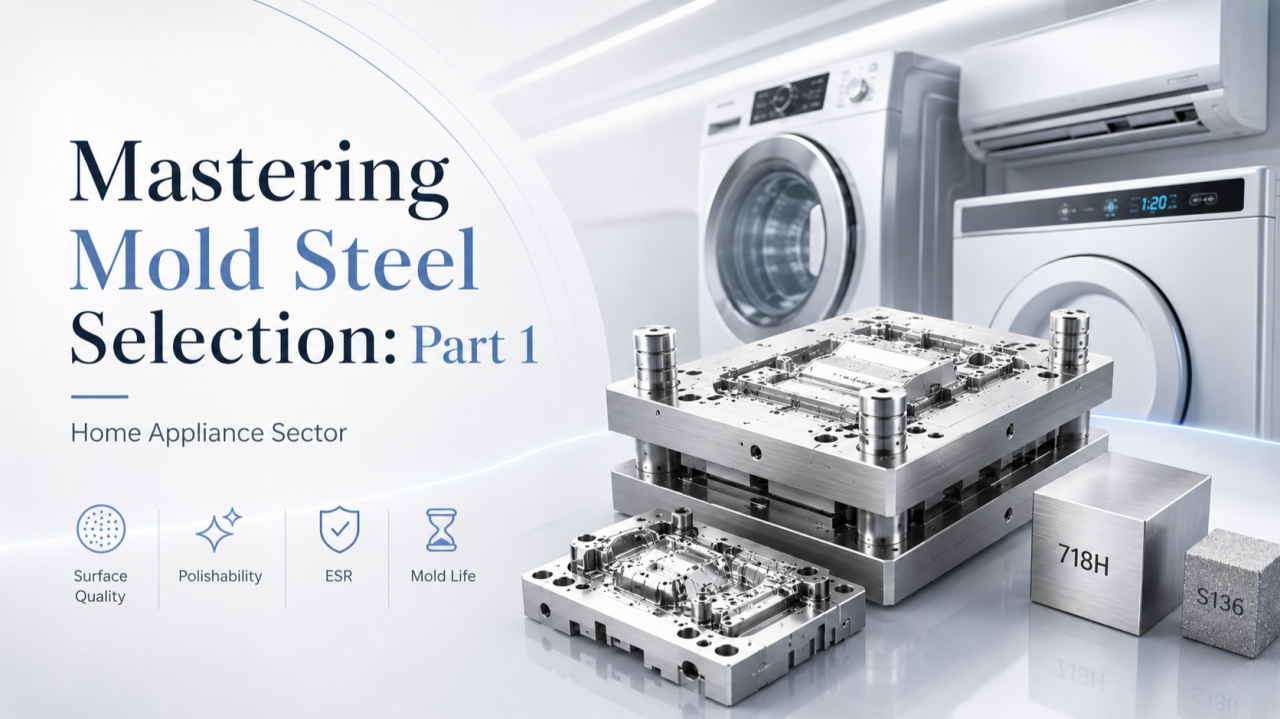
Underlying Logic and Smelting Excellence in the Home Appliance Sector
In the home appliance industry, from high-precision HVAC components to high-gloss consumer electronics parts, the intrinsic quality of mold steel directly affects production efficiency, surface quality, dimensional stability, and mold life.
For mold projects requiring a service life of 300,000 to 500,000 cycles, steel selection is not simply about choosing a familiar grade. It requires a deeper understanding of the metallurgical foundation behind the material, including chemical composition, steel cleanliness, microstructural homogeneity, heat treatment response, and polishing performance.
In other words, successful mold steel selection begins with understanding the “metallurgical DNA” of the material.
1. Function-Based Steel Selection Logic
For common resins used in home appliance applications, such as ABS, PP, and HIPS, mold steel selection can generally follow a function-based principle: matching the steel to the role of each mold component while balancing performance, machinability, cost, and expected tool life.
Appearance Parts / Cavity Side
Recommended Steel Family: 718H / P20+Ni Type Pre-Hardened Steel
For exterior panels, decorative covers, and other visible parts, the cavity side needs to provide stable polishing quality, consistent surface texture, and reliable dimensional control.
718H-type pre-hardened mold steel is based on the P20 steel family with nickel enhancement. Nickel helps improve toughness and cross-sectional hardness uniformity, especially for larger mold plates and cavity blocks.
This type of steel is usually supplied in a pre-hardened condition, typically around HRC 32–36. It helps reduce the risk of deformation from subsequent heat treatment while maintaining good machinability and surface performance.
For high-gloss home appliance parts, this steel family often provides a practical balance among surface quality, machining efficiency, and cost control.
Structural Parts / Core Side
Recommended Steel Family: 738 / 1.2738 Type Pre-Hardened Steel
For moving-side structures, core-side components, slides, lifters, inserts, and areas that are repeatedly exposed to clamping, ejection, and mechanical impact, toughness and machining stability become more important.
738 / 1.2738-type steels are widely used for mold components that require stable machinability, good toughness, and structural reliability. For areas involving complex side actions, sliding mechanisms, ejection systems, and repeated loading, this type of steel can provide reliable long-term performance when combined with proper mold design, machining, cooling, and maintenance.
In practical mold engineering, steel selection for the core side should not be based on hardness alone. Fatigue resistance, machinability, weld repair behavior, and dimensional stability should also be considered.
2. The Challenge of Transparent Parts: PMMA and PC
Transparent parts, such as display windows, light guides, transparent control panels, and optical covers, place much higher demands on mold steel.
For PMMA and PC applications, any microscopic defect on the mold surface may be visually magnified in the final molded part. Small inclusions, polishing pits, uneven microstructure, or corrosion marks in the steel may directly appear as optical defects on the part.
Precision Choice: High-Purity S136 / 420 Stainless Mold Steel
For transparent parts and high-polish applications, high-purity stainless mold steel, such as S136, is a common choice. After proper quenching and tempering, it can typically reach around HRC 48–52, offering good wear resistance, corrosion resistance, and mirror-polishing capability.
Its high chromium content helps protect polished mold surfaces from corrosion caused by moisture, additives, or acidic gases released during resin processing.
For optical-grade or demanding mirror-polish applications, ESR-grade S136 is usually a more reliable choice. The cleaner and more homogeneous the steel, the lower the risk of polishing pits, orange peel, haze, clouding, or inconsistent reflection.
3. Why Smelting Quality Defines Mold Life
The long-term performance of mold steel depends not only on its nominal grade, but also on how the steel is melted, refined, and manufactured.
Chemical composition determines the basic performance direction of the steel:
Carbon contributes to hardness and wear resistance.
Chromium improves corrosion resistance, wear resistance, and hardenability.
Nickel enhances toughness and cross-sectional uniformity.
Molybdenum helps improve strength, thermal stability, and resistance to tempering softening.
However, chemical composition alone is not enough. Two steels with similar chemical compositions may perform very differently if their cleanliness, segregation control, inclusion level, and microstructural homogeneity are different.
Cleanliness and Polishability
Non-metallic inclusions, such as oxides, sulfides, and other impurities, are often hidden problems in mirror-polishing applications. These inclusions may lead to small pits, polishing marks, surface haze, or inconsistent reflection.
For appearance parts and transparent parts, steel cleanliness is directly connected to final surface quality.
Microstructural Homogeneity
An uneven microstructure may cause unstable machining behavior, inconsistent heat treatment response, unpredictable deformation, and uneven polishing performance.
For large mold plates and large cavity blocks, cross-sectional uniformity is especially important. Some issues may not be obvious during rough machining or finish machining, but they may appear during polishing, texturing, mold trials, or long-term production.
4. The Critical Role of ESR
ESR, or Electroslag Remelting, is a secondary refining process used to improve steel cleanliness and microstructural uniformity.
During ESR processing, steel is remelted through a chemically active slag bath. This process helps remove harmful inclusions, reduce segregation, and improve the density and uniformity of the internal structure.
ESR steel usually provides the following benefits:
Higher steel cleanliness
Fewer non-metallic inclusions
More uniform microstructure
Better polishing consistency
More stable fatigue performance
Lower risk of internal defects
For high-gloss parts, transparent parts, corrosive materials, or long-life mold applications, ESR steel can provide clear performance advantages. Its value becomes even more important when the mold must maintain surface integrity over long production cycles.
5. Technical Understanding: Steel Selection Is Not a Single-Point Decision, but a System Balance
Mold steel selection is essentially a balance among performance, cost, risk, and application requirements.
There is no absolute standard that applies to every project. A successful steel selection strategy must consider resin type, part function, appearance requirements, mold size, expected life, cooling design, polishing level, maintenance plan, and customer budget.
For a mold expected to reach 500,000 cycles, the question should not simply be:
“Which steel is the best?”
A better question is:
“Which steel can provide the most reliable long-term performance at the most reasonable total cost for this specific application?”
In real engineering practice, steel selection must be evaluated together with mold structure, machining process, heat treatment plan, cooling system, surface treatment, and long-term maintenance. Only by analyzing material, design, manufacturing, and operating conditions as one integrated system can we truly improve long-term mold stability.
Conclusion
Steel selection for home appliance molds is not a simple matter of applying a grade by habit. It requires a comprehensive judgment based on part function, material characteristics, appearance requirements, life expectancy, and cost boundaries.
For general structural components, machinability, toughness, and cost balance may be the priority.
For appearance parts, polishability, hardness uniformity, and surface stability should receive more attention.
For transparent and high-gloss parts, steel cleanliness, microstructural homogeneity, and ESR processing become especially important.
A mature steel selection strategy does not pursue the highest performance from a single material. Instead, it seeks the most suitable, stable, and economical solution for a specific application.
As a mold base manufacturing team serving the home appliance, automotive, medical, and high-precision injection molding industries, we hope this type of technical discussion can bring more practical insights from professionals in mold making, injection molding, materials engineering, and precision manufacturing.
In your experience, how do you optimize material cost while still ensuring long-term reliability for high-volume molds?
We welcome your experience, perspectives, and different interpretations.
Written by Billy Peng, GM of CF-STiEHL
#MoldMaking #InjectionMolding #MoldSteel #MaterialsScience #HomeApplianceEngineering #PrecisionManufacturing #ESRProcess #SteelSelection #Tooling #EngineeringExcellence